(I'm still digging out from the ton of stuff undone over the past three weeks, so the Table of Contents is still waiting for an update, and reorganization. But I don't want to delay further some of the new posts I had prepared last week but couldn't post while traveling. So here is a start.)
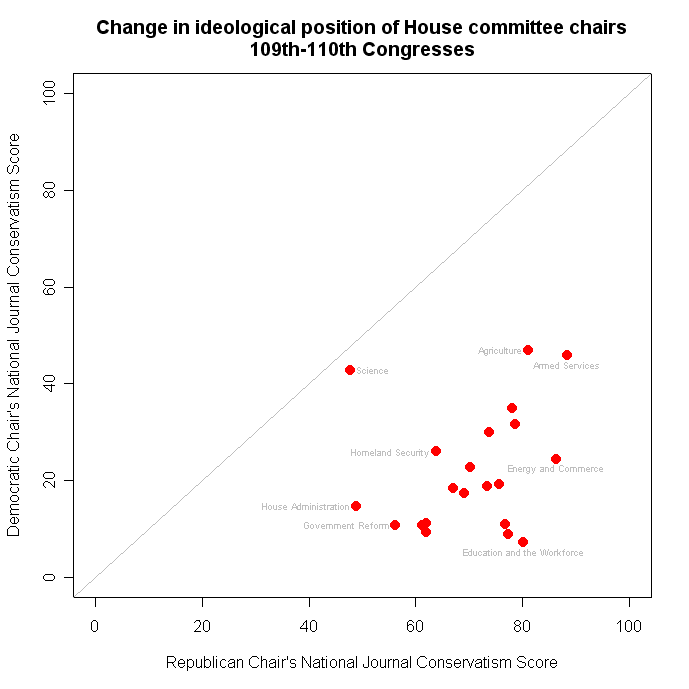
The shift in party control in Congress brings with it new committee chairs. Their outlooks give us one measure of how different the new 110th Congress may be from the 109th. Of course committee chairs are only part of what makes Congress work. We've heard and read that the Democratic leadership does not plan to give free reign to the instincts of the most liberal members. Nonetheless, the shift from generally conservative Republican chairs to generally liberal Democratic chairs is clear. The Science committee is the one substantial exception.
The graph above plots the Republican chair's vs the Democratic chair's National Journal 2005 Conservatism score, where 100 is the most conservative and 0 is the most liberal. I've used the expected chairs as reported by Congress Daily. The Intelligence committee chair appears to be the most uncertain at this point, with Speaker to be Pelosi said to be opposed to current ranking minority member Rep. Jane Harman, (D-CA). I've used Harman's National Journal score none-the-less in this plot.
It is hard to identify the cluster of points to the middle of the graph, so the dotplot below shows the shift to the left for each committee.

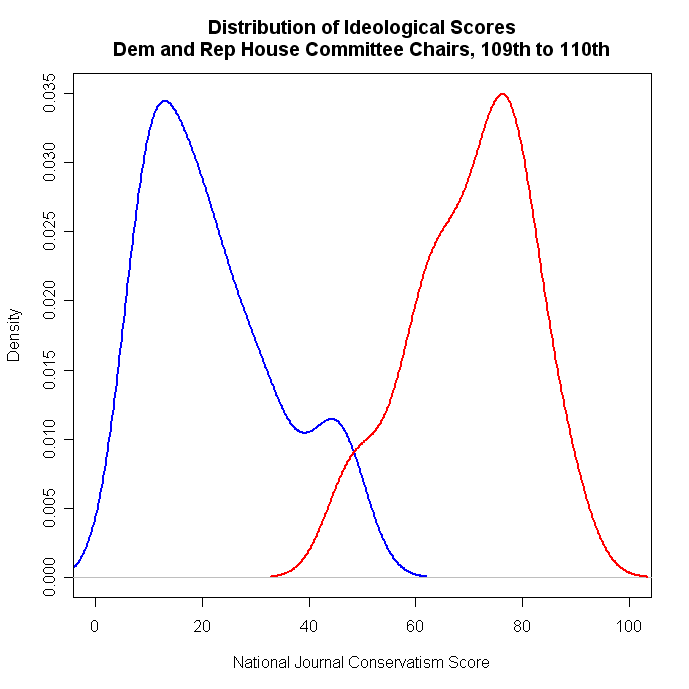
One other way to view this is to compare the distributions of the two party groups, as in the figure below. Here the polarization of the parties, and the modest overlap in the middle, is apparent. This distribution is not unrepresentative of the House as a whole. While the chairs are not an exact match, they are not wildly different from the House as a whole. The Republican chair median conservatism score is 73.3, while that for all Republicans in the House is 74.4. The median Democratic chair's conservatism score is 18.8 while the median for all Democrats is 23.25.
3 comments:
It is nice to see data confirm what we might suspect. So thanks for this. However...
These scores are based on votes that may not necessarily be related to the work of the committee. So we might expect that Agriculture Democrats could be conservative on ag votes, etc, etc. That's just a minor concern I think.
However, picking up on the Pelosi v Harman issue you mention, should we not want ideological scores that indicate how far a member is away from their party leader (i.e., how much control a leader could have over chairman/woman - assuming that ideological closeness=control)? Or you could also look at how far a member is from either chamber median or their party median.
This would get at some of the outlier hypotheses, party control hypotheses, etc. in the literature.
It also has the advantage of not having to go back and get committee-specific votes.
I would be curious as to whether the shift is as great if we look at "shifts" in this fashion. This is dependent on where Boehner and Hoyer are situated, of course, with respect to the outgoing and incoming chairs. And, perhaps, use a quadratic distance?
All way more work than you need at this point and which might very well just confirm what you are already seeing here.
Rudy
Professor Franklin,
How do you feel about the National Journal ratings vis a vis the ADA and ACU rankings? They all seem to have defects, but at least with National Journal's you can see a breakdown by economic, social, and foreign policy ratings.
Rudy--
Good points. I did a quick look and the distribution of chairs seems to mirror pretty well the distribution of the party, but I didn't do any more careful checks than that. The preference outlier point is worth considering I'm sure. These Dems do seem a little to the left of the party as a whole, though not dramatically so.
Jim--- National Journal uses a lot more votes for their rating than do the interest groups, so that is an advantage. They also correlate pretty well with the scores based on ALL roll calls, such as Keith Poole's Nominate scores, which are popular among political scientists. Nominate scores are not yet available for the 109th Congress, so I used National Journal for that reason as well.
Charles
Post a Comment