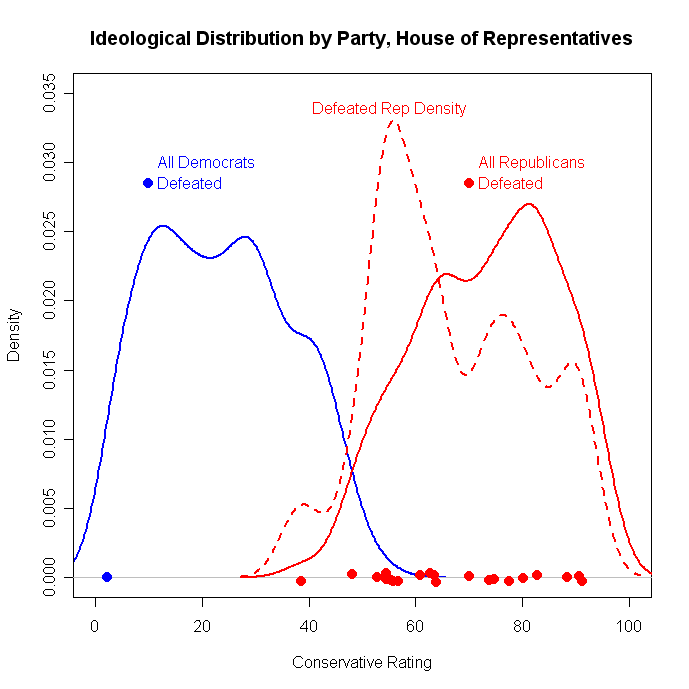
Republican losses fell along most of the ideological spectrum, but were a bit more common among moderates than among the more conservative members of the party. The graph above shows the distribution of conservatism in the House of Representatives by party, using the National Journal ratings. (I use National Journal because it is convenient to grab the data, includes more votes than the typical interest group rating and correlates highly with other (more "political science-y") measures such as Nominate scores. Nominate scores are not yet available for the 109th Congress and I don't have time to compute them myself right now. Readers interested in how Nominate scores are computed should see Keith Poole's excellent site here.)
Republican incumbents who were defeated for reelection had an average conservatism score of 66.5, while those who won averaged 74.3, a statistically significant difference. (The average for all Republicans in 2005 was 73.2, and the median was 74.4.)
This does not mean that Republicans were necessarily more vulnerable BECAUSE they were more moderate. What is left out here is the district. Moderate Republicans are more likely to come from less conservative districts, so this result may well simply reflect the more competitive nature of districts that produce more moderate Republican members. I'll take a look at that later, but for now the simple point is that the election defeat did fall more heavily among representatives with somewhat more moderate voting records.
The one Democratic defeat plotted here is Rep. Cynthia McKinney, GA-04 who lost in the primary. The plot above also includes Republican Rep. Joe Schwartz, MI-07, who also lost in a primary.

